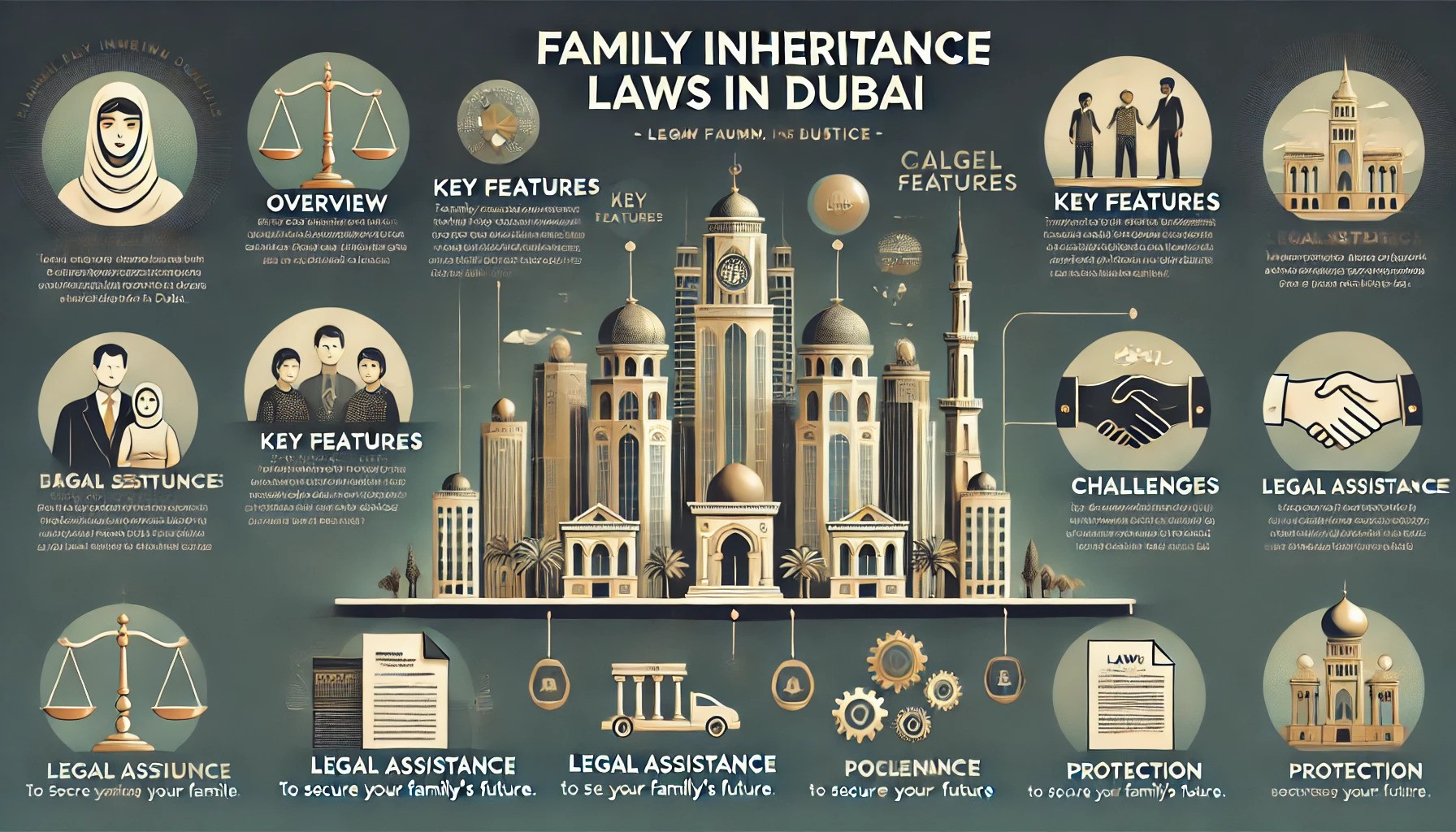
Family, Inheritance & Estate planning lawyers in Dubai, UAE at Al Adl Legal provide expert UAE Wills, Probate, Divorce & Succession, a comprehensive service to the clients in the UAE.
Connect with our senior legal team in Dubai.

For every expatriate, business owner, and family in Dubai, the most important legal question is not what you have, but what happens to it when you are gone. If you die in the UAE without a registered will, the default rules may distribute your assets, appoint guardians for your children, and determine your family's financial future in ways that bear no resemblance to your wishes. For a non-Muslim, that may mean Sharia-based distribution. For a Muslim, it means fixed Sharia shares even if your family's circumstances make a different arrangement far more appropriate. And for any parent, it means your children's guardian may be decided by a court, not by you.
The UAE's legal framework for family law and inheritance underwent its most comprehensive modernisation with Federal Decree-Law No. 41 of 2024 on Personal Status, effective 15 April 2025, which replaced the 2005 Personal Status Law and introduced new protections for expatriates, clearer inheritance provisions, and enhanced rights for women and children. Combined with Federal Decree-Law No. 41 of 2022 on Civil Personal Status, which provides full testamentary freedom for non-Muslims, and the established DIFC Wills and Probate Registry, Dubai has become one of the most legally sophisticated jurisdictions in the world for estate planning.
At Al Adl Legal Consultants, listed in Forbes and based in Dubai's Business Bay, our family and inheritance lawyers provide the complete spectrum of UAE family law services from DIFC and ADJD will registration and estate planning to probate, guardianship, divorce, child custody, prenuptial agreements, and family business succession. As UAE Ministry of Justice licensed advocates, we represent clients in Arabic-language UAE family court proceedings and in DIFC Courts for DIFC-governed matters. Your first consultation is completely free and confidential.
The UAE's family and inheritance legal framework has changed materially between 2022 and 2025. Understanding which laws apply to you and how to use them is the foundation of effective estate planning in Dubai.
Federal Decree-Law No. 41 of 2024 - The New Personal Status Law
2025 LANDMARK: Federal Decree-Law No. 41 of 2024 on the Issuance of Personal Status Law came into force on 15 April 2025, replacing Federal Law No. 28 of 2005 on Personal Status. This is the most significant reform of UAE family law in 20 years. It governs marriage, divorce, inheritance, child custody, maintenance, and guardianship for UAE citizens and Muslim expatriates.
The new Personal Status Law introduces several key changes directly affecting residents' estate planning decisions:
• Expatriates can now explicitly elect to apply the law of their home country to their inheritance matters with clearer procedural mechanisms than under the 2005 law
• Enhanced protections for women in inheritance and maintenance proceedings
• Judicial flexibility, where judges can now apply Sharia principles without being bound to a single jurisprudential school, enabling more contextual decision-making in complex family estates
• Prenuptial and postnuptial agreements are expressly recognised under the 2024 law, provided they are in writing, notarised, and not contrary to public order
• Expatriates may elect the law of their nationality to govern marital property arrangements, provided any foreign law applied does not conflict with UAE public policy
• The Inheritance Judge (separate from the Personal Status judge) now has comprehensive jurisdiction over estate administration, guardianship appointment, and distribution disputes
Muslim Inheritance in the UAE - Sharia Principles, Testamentary Freedom & Civil Wills
For Muslim residents of the UAE, both UAE nationals and expatriate Muslims, inheritance is governed bySharia principlescodified in the new Personal Status Law (Federal Decree-Law No. 41 of 2024). These principles apply automatically unless a registered civil will specifies otherwise within the limits allowed by Sharia.
• Sharia inheritance is mandatory for Muslims in the absence of a registered civil will assets pass to legally prescribed heirs in fixed proportions
• The 'one-third rule': a Muslim testator may only freely dispose of up to one-third of their estate through a will the remaining two-thirds must pass to the legal heirs in Sharia-prescribed shares
• Non-Muslim heirs cannot inherit from a Muslim estate under Sharia and a Muslim cannot inherit from a non-Muslim estate under Sharia
• No right of survivorship: jointly owned property does NOT automatically transfer to the surviving co-owner a specific provision is needed in the will or a transfer in lifetime
• Muslim expatriates in the UAE can register civil wills with the ADJD, explicitly electing to apply home country law to their UAE estate providing greater testamentary flexibility
• Abu Dhabi has gone furthest: ADJD now accepts wills from Muslim expats allowing distribution according to home country law, not default Sharia shares
Non-Muslim Inheritance in the UAE - Full Testamentary Freedom via Registered Wills
KEY RULE FOR NON-MUSLIMS: Since Federal Decree-Law No. 41 of 2022 came into force in February 2023, Sharia law does NOT apply by default to non-Muslim property owners who have a registered will in the UAE. Without a registered will, the civil statutory intestacy rules apply (50% to spouse, 50% equally among children) which still may not reflect your wishes. Registering a DIFC, ADJD, or Dubai Courts will is the ONLY way to guarantee full control.
Non-Muslims in the UAE now benefit from one of the most progressive estate planning frameworks in the Middle East. Full testamentary freedom means you can leave your UAE assets to anyone, in any proportions, without restriction subject only to proper will registration. The three registration options are:
• DIFC Will:Common law framework. English language. Enforced by DIFC Courts. Full testamentary freedom. Covers all UAE and DIFC-situated assets. Multiple will types: Full Will, Property Will, Guardianship Will, Business Owner's Will, Financial Assets Will, Cryptocurrency Will. Government fee: approximately AED 10,000 + 5% VAT for a Full Will.
• ADJD Will (Abu Dhabi Judicial Department):Available to both Muslims and non-Muslims. Civil law framework. More cost-effective: government fee from AED 950. Now accepted UAE-wide through the 2024 Personal Status Law reforms. Suitable for those with assets in any emirate.
• Dubai Courts Will:Onshore UAE registration. Government fee is approximately AED 2,020. Enforced through Dubai Courts. Cost-effective alternative to DIFC for Dubai-based assets.
Choosing the right will registration route determines how your estate will be administered, which court has jurisdiction over disputes, and the cost of registration. Al Adl's family and inheritance lawyers advise on the optimal registration route for your specific circumstances, asset profile, and nationality.
Registry | Best For | Key Details & Cost |
DIFC Wills Service Centre | Non-Muslim expatriates. High-value estates. Those wanting English common law framework. International investors with Dubai assets. | Full testamentary freedom. English language. DIFC Court jurisdiction. Will types: Full Will, Property, Guardianship, Business Owner, Financial Assets, Cryptocurrency. Government fee: Full Will approx AED 10,000 + 5% VAT. Requires 2 non-beneficiary witnesses. Virtual registration available. |
ADJD (Abu Dhabi Judicial Department) | Both Muslims and non-Muslims. UAE residents and non-residents. Cost-conscious clients. Those wanting civil law framework. | Civil Personal Status Law framework. Accepted UAE-wide. Government fee from AED 950. Virtual registration available. Muslim expats can elect home country law. Non-Muslims: full testamentary freedom. Suitable for all emirates. |
Dubai Courts (Dubai Notary) | Dubai-based assets. Those wanting onshore UAE registration. Arabic-language will preferred. | Onshore UAE registration. Government fee approx AED 2,020. Arabic-language will (English translation attached). Enforced through Dubai Courts. Cost-effective option for Dubai-based assets only. |
ADGM (Abu Dhabi Global Market) | Abu Dhabi-based financial professionals. Those wanting common law framework in Abu Dhabi. | Common law framework similar to DIFC. ADGM Court jurisdiction. Suitable for ADGM-regulated entities and professionals. |
Cost note: These are government registration fees only. Professional legal fees for will drafting are additional, typically AED 3,000–15,000+ depending on estate complexity, number of will types, and the number of assets covered. Al Adl provides transparent, all-inclusive quotes at the free initial consultation.
Al Adl Legal provides comprehensive family law and estate planning services for individuals, families, and business owners across Dubai and the UAE. Our family lawyers are UAE Ministry of Justice licensed advocates meaning we appear in Dubai Family Courts and UAE courts in Arabic, represent clients in DIFC Courts in English, and provide legally binding advice on UAE family law.
Will Drafting, Registration & Estate Planning
A properly drafted and registered will is the single most important legal document you can create in the UAE. It determines who inherits your assets, who cares for your children, who manages your estate, and for non-Muslims, whether Sharia distribution applies or whether you retain full testamentary freedom. Al Adl's family lawyers draft all types of UAE wills and manage registration with the appropriate authority.
• Full Will (DIFC):comprehensive will covering all UAE assets, real estate, bank accounts, investments, business interests, personal property
• Guardianship Will:appointing guardians for minor children, the single most important document for parents with children under 21 in the UAE
• Business Owner's Will:succession planning for company shares, business assets, and ownership continuity
• Financial Assets Will (DIFC): covering bank accounts, investment portfolios, and financial instruments
• Cryptocurrency Will (DIFC):covering digital assets, crypto holdings, and NFTs an increasingly important estate planning component
• ADJD Will:cost-effective option for both Muslims and non-Muslims, civil law framework accepted UAE-wide
• Mirror Wills (for couples):complementary wills for spouses or civil partners with coordinated inheritance provisions
• Regular will review and update services:reviewing existing wills for compliance with 2025 Personal Status Law amendments
Probate & Estate Administration
When a person dies in the UAE with or without a will, their estate must be administered through the relevant UAE court or authority. Without a valid registered will, this process can take months or years, bank accounts are frozen immediately, and assets may be distributed in ways the deceased never intended. Al Adl's inheritance lawyers manage the complete estate administration process from initial court filings through to final distribution.
• Probate applications:representing executors in UAE Courts (Dubai Courts, Abu Dhabi Courts) for estate administration of registered wills
• Intestate estate administration:managing the legal process for estates where no valid will exists, applying applicable law (Sharia or civil) to asset distribution
• Bank account unfreezing:assisting beneficiaries in unfreezing UAE bank accounts following a death, a critical first step in UAE estate administration
• Asset identification and valuation:locating and valuing all UAE-situated assets, property, bank accounts, business interests, vehicles, investments
• Powers of Attorney for estate administration:drafting and attesting POAs enabling beneficiaries overseas to act in UAE estate proceedings
• Foreign will recognition in UAE:facilitating UAE recognition of wills registered in the deceased's home country, procedures vary by emirate
• Cross-border estate coordination:managing estates with assets in multiple jurisdictions alongside international legal counsel where required
Guardianship - Protecting Your Children
If you have children under 21 in the UAE and you die without appointing guardians in a valid will, a court will appoint guardians, and that decision may not reflect your wishes. This is the most urgent estate planning decision for parents of minor children in Dubai, and it requires specific legal action: a Guardianship Will registered with DIFC or ADJD.
• Guardianship Will (DIFC):appointing interim and permanent guardians for minor children, enforceable through the DIFC Courts
• ADJD Guardianship provisions:naming preferred guardians in an ADJD-registered will for UAE-wide enforceability
• Emergency guardianship orders:court applications for urgent guardianship arrangements where required
• Guardianship disputes:representing family members in contested guardianship proceedings before UAE Family Courts
• Special needs guardianship:establishing long-term care and financial provisions for children or family members with special needs
• Review and update of guardianship arrangements:updating existing guardianship nominations as children age or circumstances change
Divorce & Separation Advisory
Divorce proceedings in the UAE involve a unique intersection of federal law (Federal Decree-Law No. 41 of 2024), applicable personal law (UAE law, home country law, or DIFC law depending on the parties' status), and Sharia principles where applicable. Al Adl's family lawyers guide clients through UAE divorce proceedings with sensitivity, strategy, and expert knowledge of which legal framework applies to their specific situation.
• Contested and uncontested divorce:representing clients in Dubai Family Court, Abu Dhabi courts, and DIFC Courts
• Jurisdiction analysis:determining which country's law governs the divorce, UAE law, home country law, or DIFC common law
• Financial settlement:division of UAE assets (property, bank accounts, investments, business interests) on divorce
• Maintenance and spousal support:advising on UAE maintenance obligations and representing clients in maintenance claims
• Recognition of foreign divorces in UAE:procedures for registering overseas divorce decrees in the UAE
• Prenuptial agreement enforcement:representing clients seeking to enforce prenuptial agreements in UAE divorce proceedings
Child Custody, Support & Maintenance
Child custody disputes in the UAE are among the most emotionally and legally complex proceedings in family law. UAE courts apply the principle of the child's best interests, but the applicable legal framework differs for Muslims (Sharia-based custody rules under the new Personal Status Law) and non-Muslims (civil rules under Federal Decree-Law No. 41 of 2022). Al Adl's family lawyers represent both mothers and fathers in custody proceedings across all UAE courts.
• Custody orders:representing parents in UAE Family Court proceedings to establish or modify custody arrangements
• Visitation rights:securing rights of access for the non-custodial parent under UAE law
• Relocation disputes:representing parents in cases where the custodial parent seeks to leave the UAE with the children
• Child support orders: calculating and enforcing child maintenance obligations under UAE law
• International child abduction:advising on cases involving the Hague Convention and the UAE's international family law obligations
• Emergency custody orders:applying for urgent interim custody arrangements where the child's welfare is at immediate risk
Prenuptial & Postnuptial Agreements
Under Federal Decree-Law No. 41 of 2024, prenuptial and postnuptial agreements are now expressly recognised in the UAE, provided they are in writing, notarised, and do not contravene UAE public order. For expatriate couples, a carefully drafted prenuptial agreement can govern asset division on divorce, protect pre-marital wealth, and specify which country's law governs their marital financial arrangements.
• Prenuptial agreements:drafting asset protection arrangements before marriage, protecting property, business interests, and inherited wealth
• Postnuptial agreements:restructuring financial arrangements during marriage following asset acquisition, business success, or family changes
• Cross-border prenuptials: ensuring agreements are enforceable in both UAE and the parties' home countries
• Prenuptial review:reviewing existing prenuptial agreements for compliance with Federal Decree-Law No. 41 of 2024
• Prenuptial enforcement:representing clients seeking to enforce or challenge prenuptial agreements in UAE divorce proceedings
Family Business Succession & Continuity Planning
Family businesses represent the backbone of Dubai's economy and ensuring their continuity across generations requires a coordinated legal strategy that integrates estate planning, corporate structuring, and family governance. Without a proper succession plan, a family business can be devastated by contested inheritance, forced sales of shares to settle estate duties, or governance disputes between inheriting family members.
• Family business succession plans:integrating will provisions, shareholder agreements, and corporate structures to protect business continuity
• Succession provisions in constitutional documents:using the 2025 CCL amendments to specify share succession in company MOAs
• DIFC Foundation structure:establishing DIFC Foundations for long-term family wealth and business asset protection, ideal for multi-generational planning
• Holding company succession:structuring business assets within a holding company for seamless transfer to the next generation
• Family constitution drafting:governance frameworks for family businesses, decision-making, management succession, and conflict resolution
• Business valuation for estate planning:coordinating with valuers to ensure estate plans accurately reflect business asset values
DIFC Foundations - Advanced Wealth Protection Structures
Family law and estate planning require lawyers who combine deep legal knowledge with genuine personal commitment to protecting your family's future. Al Adl's family lawyers bring both.
UAE Ministry of Justice Licensed Advocates:Al Adl's family lawyers hold full UAE advocate licences, conducting Arabic-language court proceedings in Dubai Family Courts, UAE courts of appeal and cassation, and English-language proceedings in DIFC Courts, without needing to instruct separate advocates.
Current Law Expertise:Al Adl's family law practice reflects the current regulatory position: Federal Decree-Law No. 41 of 2024 (in force 15 April 2025), Federal Decree-Law No. 41 of 2022 (Civil Personal Status), and the 2025 DIFC Wills Probate Rules. Unlike many competitors using outdated 2005 Personal Status Law references, Al Adl's advice is current.
All Will Types:DIFC Wills (Full, Property, Guardianship, Business Owner, Financial Assets, Cryptocurrency), ADJD Wills, Dubai Courts Wills. Al Adl advises on the optimal registration route for each client's specific circumstances, nationality, and asset profile.
Complete Family Law:Al Adl provides more than wills: divorce, child custody, maintenance, prenuptial agreements, guardianship, and family business succession. Unlike specialist will firms that cannot represent clients in court, Al Adl handles the complete family law journey.
Muslim & Non-Muslim Expertise:Al Adl advises both Muslim and non-Muslim clients on Sharia inheritance planning, Muslim civil will registration with ADJD, and non-Muslim testamentary freedom under the 2022 and 2024 personal status laws. A bilingual Arabic-English team ensures precision in every context.
DIFC Foundation Specialists:Al Adl structures DIFC Foundations for high-net-worth families seeking wealth protection, succession planning, and long-term asset control one of the most sophisticated estate planning tools in the UAE.
Family Business Integration:Al Adl integrates estate planning with corporate structuring ensuring family business succession plans are coordinated with company constitutional documents, shareholder agreements, and the 2025 CCL amendments.
Forbes-Listed Law Firm:Al Adl Legal's Forbes recognition provides institutional authority that specialist will firms and smaller boutiques cannot match. For high-value family estates, this credibility matters.
Absolute Confidentiality:Family law and estate matters involve your most personal information. All communications with Al Adl are protected by absolute legal professional privilege.
First Consultation:No commitment, no fee. Understand your estate planning options and family law position before committing to any course of action.



If you die in Dubai without a valid registered will for non-Muslims, Federal Decree-Law No. 41 of 2022 (Civil Personal Status Law) provides a default distribution 50% to the surviving spouse and 50% equally among children, with no differentiation between males and females. If there are no children, 50% goes to surviving parents. This may not reflect your wishes. For Muslims, Sharia distribution applies automatically, assets pass to legally prescribed heirs in fixed proportions according to Islamic law. Without a will, all UAE bank accounts are frozen immediately on death, real estate cannot be transferred, and the estate administration process typically takes 12-24 months. For parents: if you die without a Guardianship Will, a court, not you, decides who cares for your minor children.
There are three main options for registering a will in Dubai. (1) DIFC Wills Service Centre: best for non-Muslims wanting an English common law framework with DIFC Court jurisdiction. Multiple will types available (Full Will, Guardianship, Property, Business Owner, Cryptocurrency). Government fee: approximately AED 10,000 + 5% VAT for a Full Will. Virtual registration available. (2) ADJD (Abu Dhabi Judicial Department): available to both Muslims and non-Muslims. Government fee from AED 950. Accepted UAE-wide. Good option for cost-conscious clients and Muslim expats wanting to apply home country law. (3) Dubai Courts: onshore UAE registration for Dubai-based assets. Government fee is approximately AED 2,020. Arabic-language will be required. Al Adl guides clients through the optimal registration option for their specific situation, nationality, and asset profile. Professional drafting fees are additional Al Adl provides transparent quotes at the free initial consultation.
Since Federal Decree-Law No. 41 of 2022 on Civil Personal Status came into force in February 2023, Sharia law does NOT automatically apply to non-Muslim property owners who have a registered will in the UAE. Without a registered will, the civil statutory intestacy rules apply (not Sharia 50% to spouse, 50% equally among children). With a valid registered will (DIFC, ADJD, or Dubai Courts), non-Muslims have full testamentary freedom to leave their UAE assets to anyone, in any proportions, including people outside their immediate family or even charitable organisations. The critical point: full testamentary freedom only applies if you have a registered will. Without one, the civil intestacy formula not govern your wishes.
Government registration fees in Dubai: DIFC Full Will approximately AED 10,000 + 5% VAT. DIFC Guardianship Will only cost approximately AED 7,000 + 5% VAT. ADJD Will from AED 950 (significantly more cost-effective). Dubai Courts will approximately AED 2,020. These are government fees only. Professional legal drafting fees are typically additional, ranging from AED 3,000 to AED 15,000+, depending on estate complexity, the number of will types required, the number and nature of assets covered, and any cross-border considerations. Al Adl provides all-inclusive transparent quotes at the free initial consultation covering both government fees and professional drafting fees with no hidden costs.
Yes. The DIFC Wills Service Centre offers a dedicated Cryptocurrency Will specifically designed to cover digital assets, cryptocurrency holdings, and NFTs. This is one of the most important developments in UAE estate planning in recent years as digital assets can be permanently lost if beneficiaries do not have access credentials. A DIFC Cryptocurrency Will can specify the location of digital assets, access procedures, and designated beneficiaries. For assets held on regulated exchanges, additional documentation may be required. Al Adl advises on comprehensive digital asset estate planning from cryptocurrency will registration to NFT ownership documentation.
Federal Decree-Law No. 41 of 2024 on Personal Status (effective 15 April 2025) replaced the 2005 Personal Status Law with significant changes: (1) Expatriates can now more clearly elect to apply their home country law to their UAE inheritance matters. (2) Prenuptial and postnuptial agreements are expressly recognised, provided they are written, notarised, and not contrary to public order. (3) Judges have greater flexibility in applying Sharia principles without being bound to a single jurisprudential school. (4) Enhanced protections for women and children in inheritance and maintenance proceedings. (5) The Inheritance Judge now has comprehensive jurisdiction over all estate administration matters. Combined with Federal Decree-Law No. 41 of 2022 (full testamentary freedom for non-Muslims), existing wills should be reviewed for compatibility with the new 2025 framework.
A DIFC Foundation is a legal entity created under DIFC law that holds assets for the benefit of designated beneficiaries, similar in function to a trust, but structured as a legal person under DIFC Foundations Law 2018. Unlike a will (which activates on death), a DIFC Foundation is established and operational during the founder's lifetime, providing (1) Asset protection from personal creditors (2) Succession planning without probate delay (3) Multi-generational wealth planning (4) Privacy - Foundation assets are not distributed through public court proceedings (5) Business continuity - company shares can be held within the Foundation with clear succession provisions. A DIFC Foundation is particularly valuable for high-net-worth individuals with complex asset portfolios, family business owners seeking succession certainty, and families with multi-jurisdictional assets.

Our team of highly-skilled and experienced lawyers specialize in a variety of areas of practice. With a comprehensive knowledge of UAE legislation, we are well-equipped to provide strategic counsel and effective solutions.

We prioritise our clients' interests and strive to deliver personalised legal solutions. We take the time to thoroughly understand your unique situation, objectives, and concerns. By developing a close working relationship with you, we can provide sound advice and guidance.

Our dedication to excellence sets us apart. We are committed to delivering exceptional legal services, consistently meeting and exceeding our clients' expectations. With meticulous attention to detail, thorough research, and diligent case preparation, we leave no stone unturned.

We uphold the highest standards of integrity and professionalism in all our interactions. We understand the sensitive nature of legal matters and the importance of confidentiality. Rest assured that your information will be handled with the utmost discretion and respect.
Clients
AED Recovered
Countries
Success Rate